
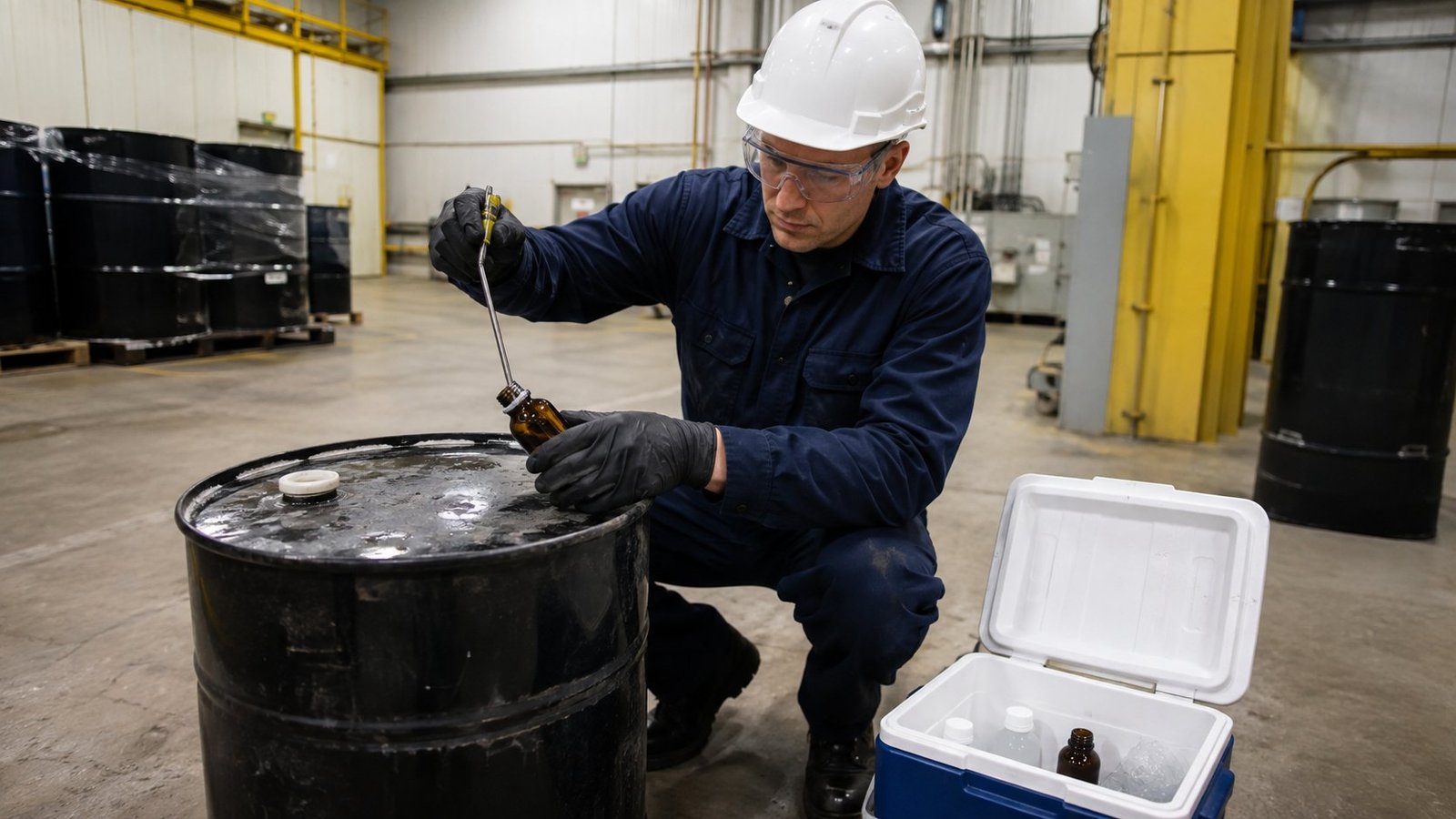
TCLP vs. Total Analysis: What Each Result Actually Means
Quick answer: A total analysis estimates how much of a constituent is in a waste sample. The Toxicity Characteristic Leaching Procedure (TCLP) measures the concentration in an extract prepared under a specified laboratory procedure. They answer different questions. Neither result alone settles every hazardous waste determination.
A lab report can contain two numbers for the same metal that look difficult to reconcile. The difference is often the question asked. Total analysis focuses on the constituent in the material; TCLP focuses on what enters an extract under Method 1311. The federal toxicity characteristic compares a representative sample’s TCLP extract with constituent-specific limits in 40 CFR 261.24. A result equal to or above a listed limit meets that constituent’s toxicity characteristic criterion.
What a total result tells you
A total analysis measures the amount of a selected constituent in the material as analyzed, using a specified preparation and analytical method. A solid result is commonly reported in milligrams per kilogram (mg/kg); a liquid result is commonly reported in milligrams per liter (mg/L). The laboratory’s method, reporting basis, detection limits and sample preparation matter. A result is not a measurement of every hazardous constituent unless the analysis actually covers them.
Total concentrations can inform waste characterization, treatment evaluation and other requirements. They do not automatically predict the amount that will leach in the TCLP. Different materials can hold the same total amount while releasing different amounts under the test conditions.
What a TCLP result tells you
EPA Method 1311 specifies how to prepare an extract and analyze it for relevant constituents. Depending on the sample, the method addresses filterable liquid, solids and multiple phases. For a solid phase, the procedure uses extraction fluid in a 20-to-1 liquid-to-solid ratio. The extract result is usually reported in mg/L and is compared with the applicable constituent’s federal toxicity characteristic level.
Think of it as a standardized laboratory test of mobility, not a direct prediction of exactly what will happen at every disposal site. Sampling and analytical quality matter: an unrepresentative sample or an unsuitable reporting limit can weaken the conclusion. The generator’s broader determination also includes whether the waste is excluded, listed, or exhibits another characteristic. 40 CFR 262.11 addresses the determination and recordkeeping duties.
Why totals sometimes screen out a TCLP test
Method 1311 allows total analysis in place of extraction for an individual analyte when it shows that the analyte is absent or present at such a low level that the applicable regulatory level could not possibly be exceeded. EPA explains that, for a waste that is 100% solid as defined by the TCLP procedure, the total concentration in mg/kg can be divided by 20 to estimate the maximum theoretical extract concentration in mg/L. This is a conservative screening calculation, not a measured TCLP result. EPA’s hazardous waste characteristics guidance explains the distinction.
For example, suppose a representative, TCLP-defined 100% solid sample contains 40 mg/kg total lead. Under the stated assumptions, 40 divided by 20 gives a maximum theoretical extract concentration of 2 mg/L. That is below the federal lead toxicity characteristic level of 5 mg/L. This hypothetical screen addresses lead’s toxicity characteristic only; it does not establish the waste’s complete status. If the calculated maximum were 8 mg/L, it would not prove a TCLP failure: the actual extract might be lower, so more information could be needed.
Do not apply the divide-by-20 shortcut blindly. A waste with filterable liquid requires the liquid and solid phases to be considered using the method and appropriate calculation. For a liquid that passes the method’s filtration step, EPA explains that the filtrate is treated as the TCLP sample and compared directly after any analytical dilution correction. Mixed or unusual matrices, units, dry versus wet reporting basis, representative sampling and detection limits all need careful attention. Ask the laboratory to explain the method and basis before interpreting the numbers.
Common misconceptions
- “A high total always means a failed TCLP.” No. A total result can exceed a screening value without establishing the measured extract concentration.
- “A low TCLP result means the waste is not hazardous.” Not necessarily. A listing or another characteristic may apply. A TCLP result below one limit does not evaluate every constituent or every rule.
- “Passing TCLP removes a listing.” No. Listed-waste status depends on applicable listing and regulatory provisions, not simply a low extract result.
- “The numbers can be compared as printed.” Check the analyte, units, matrix, reporting basis, method and applicable threshold first.
Keep the evidence together
Retain the process description, sampling rationale, laboratory report, methods, calculations and the basis for the determination. Revisit the evaluation when materials, processes or other relevant conditions change. Federal recordkeeping requirements apply; state rules may differ or be more stringent.
This article describes the federal baseline for education, not legal advice or a determination for a particular waste. Check the rules and agency interpretations applicable in your state.
Primary sources reviewed October 26, 2026.


One Comment
Comments are closed.