Hazardous Waste Training: SQG and LQG Responsibilities
Hazardous Waste Training: SQG and LQG Responsibilities
How to match instruction, job duties, emergency roles, timing, records, and demonstrated competency to the generator category.
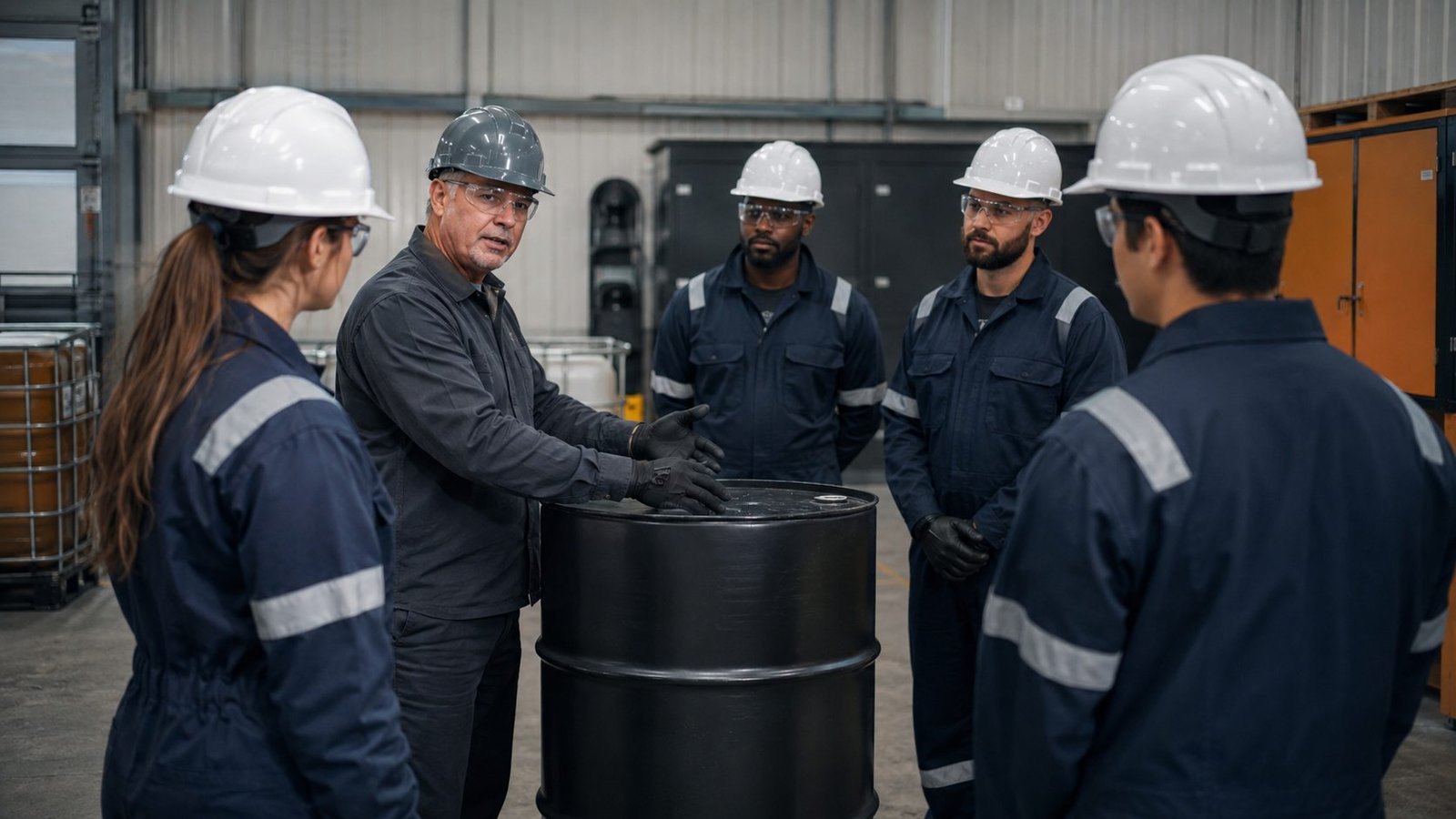
SQG personnel must be thoroughly familiar with proper waste handling and emergency procedures relevant to their responsibilities. LQG personnel must complete a documented program directed by a qualified person, including instruction tied to their duties and emergency procedures, within six months of assignment and receive annual review. Employees may work unsupervised only after completing required LQG training.
Start with category and job duties
Training is not one universal annual presentation. The federal requirement changes with generator category, and the content changes with what each person does.
SQG employees must be thoroughly familiar with proper waste handling and emergency procedures relevant to their responsibilities. LQGs must maintain a more formal personnel training program under 40 CFR 262.17(a)(7), directed by a person trained in hazardous waste management procedures and covering the procedures relevant to each position.
Build the LQG program around positions
The LQG program may use classroom instruction, online instruction, or on-the-job training, but it must teach personnel to perform duties in compliance with the generator standards. It must include emergency procedures, equipment, and systems needed for an effective response, including applicable communication or alarm systems, response to fires or explosions, shutdown operations, and groundwater-contamination response when relevant.
New personnel must complete required training within six months after employment or assignment to a new position and work under direct supervision until then. Personnel must take part in an annual review of the initial training.
Maintain job titles, written job descriptions, the name of the employee filling each job, descriptions of the required training, and records that document completion. Keep current personnel training records until facility closure and former personnel records for at least three years from the date the employee last worked at the facility.
Use a role-to-task training matrix
List the tasks that affect compliance: making determinations, adding waste, closing containers, inspecting areas, moving SAA excess, signing manifests, preparing DOT packages, operating aerosol puncturing equipment, managing spills, maintaining records, and approving vendors. Map each task to the positions allowed to perform it.
For each cell, identify the governing training, the instructor or qualification, initial timing, refresher timing, competency check, and record owner. This prevents a general awareness course from being treated as authorization for specialized work.
Verify competency where the work occurs
A roster proves attendance. It does not prove that an employee can select the right label, close a funnel, recognize an SAA limit, inspect a drum, or execute an emergency action. Use observation, demonstration, scenarios, short knowledge checks, and supervised practice appropriate to the role.
Contractors need role-specific controls too. Determine which requirements apply to their functions, document facility orientation and boundaries, and do not assume their employer’s generic training covers the site’s waste streams and emergency procedures.
Worked example: a promoted maintenance lead
Simplified example. A technician who previously added used oil is promoted to supervise hazardous waste accumulation and sign shipping documents. The training coordinator compares the old and new job descriptions. The employee receives site-specific RCRA instruction, emergency duties, inspection practice, and separate DOT hazmat employee training before performing shipping functions unsupervised.
The competency record shows a field inspection and a shipment-document exercise. The matrix also triggers an annual review and retraining when procedures or assigned duties change.
Common training mistakes
- Giving every employee the same generic course.
- Treating a signed roster as proof of ability.
- Missing the LQG six-month initial deadline or annual review.
- Allowing unsupervised LQG work before training is complete.
- Leaving emergency duties out of position training.
- Failing to update training after a promotion or process change.
- Confusing RCRA training with DOT, OSHA, or equipment-specific training.
- Discarding former employee records too early.
Field checklist
- Confirm the generator category for each month.
- List every position that affects hazardous waste management.
- Connect job descriptions to actual tasks and emergency duties.
- Identify RCRA, DOT, OSHA, state, and equipment training separately.
- Assign qualified instructors and appropriate delivery methods.
- Meet initial, supervision, and refresher timing requirements.
- Verify competency through job-relevant demonstrations or scenarios.
- Track role changes, contractors, absences, and overdue items.
- Retain current and former employee records for the required period.
- Revise the matrix after process, rule, plan, or equipment changes.
Frequently asked questions
Does an SQG need annual RCRA training under the federal rule?
Can online training satisfy LQG requirements?
Does RCRA training satisfy DOT hazmat training?
Check your state rules
Authorized states may require annual SQG training, state-specific course content, certifications, or longer retention. OSHA, fire-code, permit, and company programs can impose separate training duties.
Primary sources
- 40 CFR 262.16(b)(9)(iii) — SQG employee familiarization
- 40 CFR 262.17(a)(7) — LQG personnel training
- 49 CFR 172.704 — DOT hazmat employee training
Federal sources reviewed September 6, 2026. Verify the current text and the rules adopted in your jurisdiction before acting.
This article explains a general federal baseline. It is not a facility-specific determination or legal advice. Verify current federal, state, permit, and local requirements for your facts.