
DOT Hazmat Employee Training: Who Needs It and What Records Prove It
DOT Hazmat Employee Training: Who Needs It and What Records Prove It
Identify hazmat employees, map function-specific duties, complete initial and recurrent training, test competence, and retain compliant records.
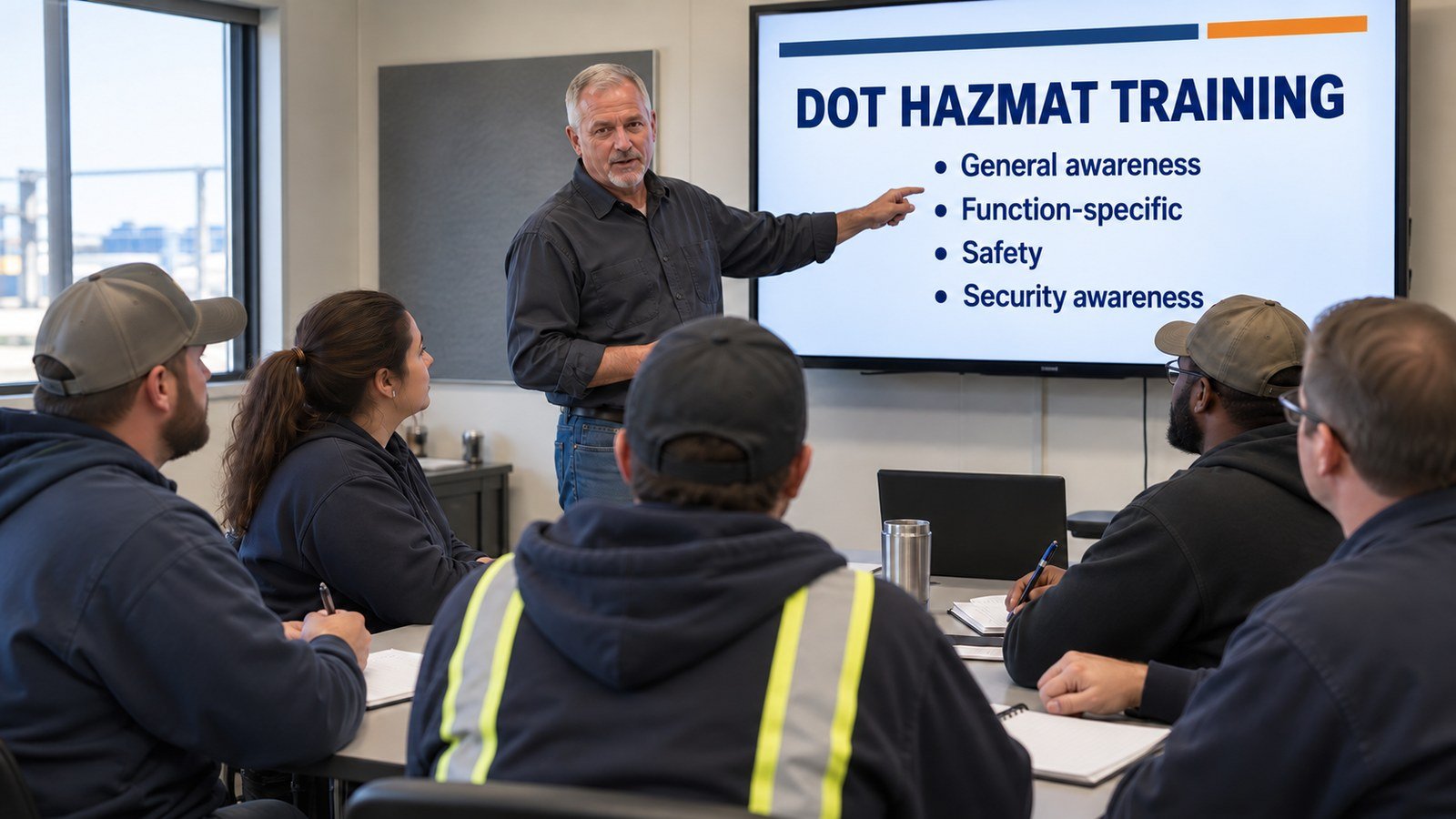
Each hazmat employer must train, test, certify, and retain records for every hazmat employee. Training must cover general awareness, function-specific duties, safety, security awareness, and in-depth security when a security plan applies; drivers need applicable modal training. Complete initial training within the allowed period under direct supervision and recurrent training at least every three years.
Identify hazmat functions
Map who classifies, selects packaging, marks or labels, completes or signs shipping papers, loads, blocks and braces, operates vehicles, maintains packaging, or directly affects transportation safety. Job title alone does not decide coverage.
Build role-specific curricula
Combine general awareness with the exact regulations, procedures, tools, packaging, modes, and exceptions used by each role. Include emergency response information and security responsibilities.
Train, test, and certify
New or reassigned employees may perform functions during the initial period only under direct supervision of a properly trained and knowledgeable employee. Document testing and employer certification.
Worked example: shipping coordinator
A coordinator prepares hazardous waste manifests and DOT descriptions but does not load trucks. The employer assigns general, security, safety, and function-specific modules for classification and shipping papers, then documents testing and recurrent due date.
Control records and changes
Keep employee name, completion date, training materials or location, trainer name and address, and certification. Retrain when functions or regulations change and track the three-year cycle.
Put the requirement into daily work
Assign an accountable owner and translate the DOT hazmat employee training decision into a field standard. Identify who performs each step, who reviews exceptions, what training and equipment are required, and where evidence is retained. Test the workflow with a real facility example before broad use.
Connect environmental, operations, maintenance, laboratory, purchasing, shipping, emergency-response, and contractor roles where their decisions affect the outcome. Use clear acceptance criteria so the same facts produce the same decision.
Records and reevaluation triggers
Keep the current regulatory basis, facility analysis, approvals, operating records, and exception history under a stable identifier. A reviewer should be able to reconstruct what was known, who decided, how the control was implemented, and how ongoing performance was verified.
Reevaluate after changes in material, process, equipment, quantity, storage, handling, vendor, destination, permit, law, incident, inspection finding, analytical result, or recurring failure. Document both the trigger and the resulting decision.
Common mistakes
- Training only drivers.
- Using one generic course for every function.
- Counting attendance as testing.
- Missing changed-function training.
- Discarding prior training records too early.
Field checklist
- Inventory all hazmat functions and employees.
- Map required training to each role.
- Provide initial training and direct supervision.
- Test and certify competence.
- Track recurrent training every three years.
- Retain complete training records.
Frequently asked questions
Are environmental employees automatically hazmat employees?
Can prior-employer training be credited?
How often is recurrent training required?
Check your state rules
Authorized states may be more stringent, broader in scope, or use different adoption and reporting rules. Verify current requirements and agency interpretations in every applicable jurisdiction.
Primary sources
- 49 CFR 172.704 – Training requirements
- PHMSA – Training Requirements for Industry
- 49 CFR 171.8 – Hazmat employee definition
Federal sources reviewed September 7, 2026. Verify the current text and the rules adopted in your jurisdiction before acting.
This article explains a general federal baseline. It is not a facility-specific determination or legal advice. Verify current federal, state, permit, and local requirements for your facts.