Weekly Hazardous Waste Container Inspections: What to Check and Record
Build a repeatable weekly inspection route that identifies container problems, assigns corrective action, and preserves closure evidence.
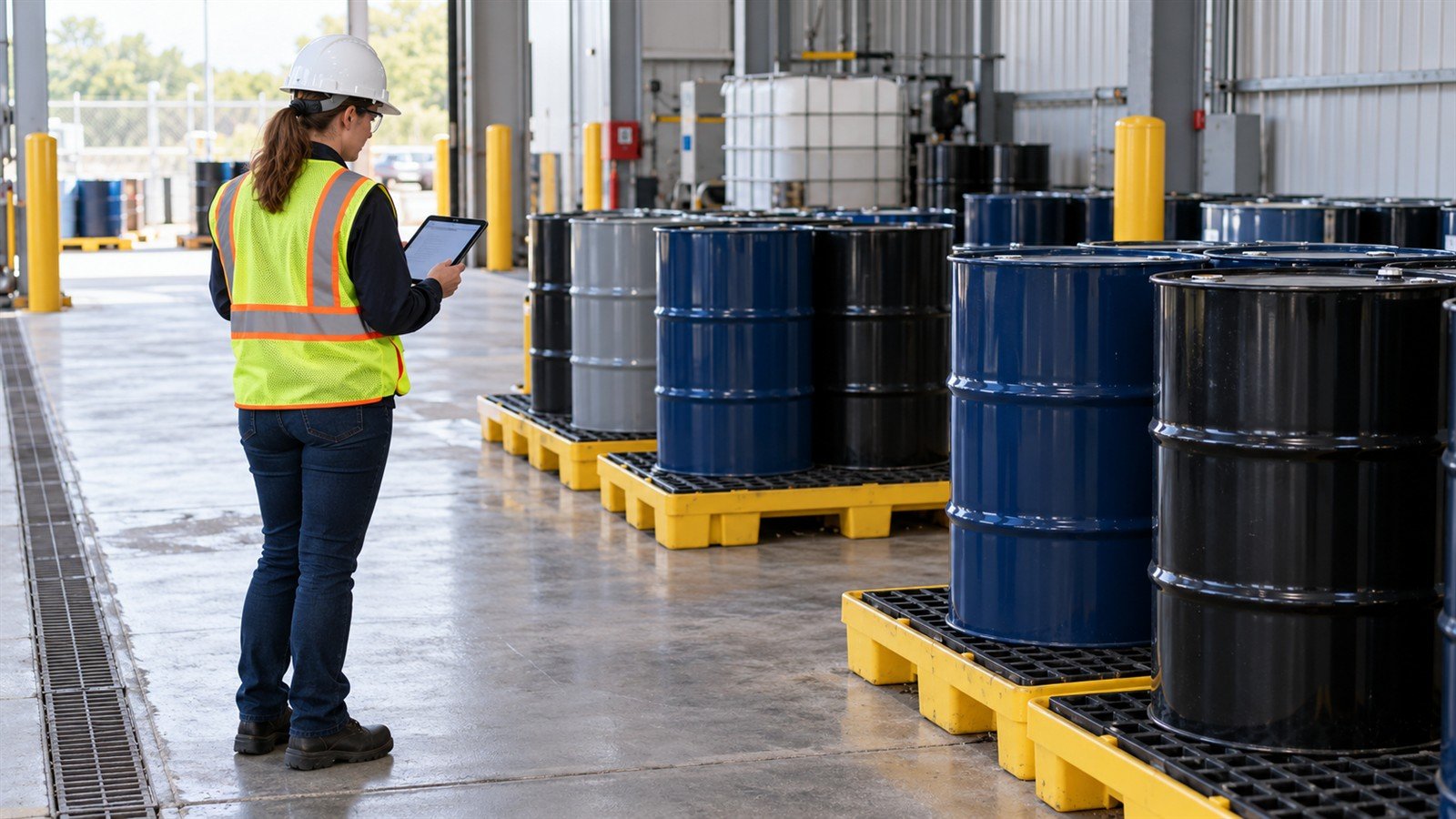
Federal SQG and LQG container-accumulation provisions require at least weekly inspections of central accumulation areas where containers are stored. Inspect for leaking containers and deterioration caused by corrosion or other factors. A useful record should also show the area, date, inspector, containers or conditions reviewed, findings, immediate controls, corrective actions, completion, and escalation. States, permits, fire codes, and facility procedures may require more.
Confirm which areas are covered
Start with the generator category and accumulation pathway. SQG container conditions are in 40 CFR 262.16, and LQG container conditions are in 40 CFR 262.17. Both incorporate weekly inspection requirements for qualifying container accumulation areas.
Do not automatically apply the same rule to every container onsite. Satellite accumulation areas operate under 40 CFR 262.15, which does not contain the same federal weekly container-inspection provision. Universal waste, used oil, products, empty containers, and permitted units follow their own rules. A facility may voluntarily inspect them on the same route, but the record should distinguish regulatory and facility-program checks.
Inspect the physical condition
The federal text directs the generator to look for leaking containers and deterioration caused by corrosion or other factors. A practical route should examine:
- visible leaks, stains, residue, wetness, bulging, or pressure indicators;
- corrosion, dents, punctures, damaged seams, degraded gaskets, or loose closures;
- whether containers are closed except when adding or removing waste or as otherwise allowed;
- compatibility of the waste with the container and nearby materials;
- accumulation dates and required hazardous-waste and hazard indications;
- aisle space, access, containment, and emergency equipment required by the applicable program;
- ignitable, reactive, or incompatible-waste separation and special controls; and
- evidence that the physical area differs from the approved layout or procedure.
Treat this broader list as a facility control system. Identify which items are federal requirements, state or permit conditions, fire-code controls, or internal expectations.
Define “weekly” conservatively
The cited federal provisions say “at least weekly.” They do not create one universal inspection day or a substitute for prompt response to an observed problem. Establish a recurring schedule that reliably prevents a gap longer than the facility’s defined interval and that satisfies any more specific state interpretation.
Plan for weekends, holidays, shutdowns, severe weather, staffing gaps, and restricted access. If an inspection is late or missed, document the facts, inspect promptly, evaluate any period of uncontrolled risk, and correct the scheduling system.
Record findings that can be closed
A checked box without location or resolution may not demonstrate that a problem was managed. For each finding, record:
- exact area and container identifier;
- observed condition and date;
- whether active leakage or imminent risk existed;
- immediate action, such as overpacking, transfer, isolation, cleanup, or stopping additions;
- person responsible for permanent correction;
- target and completion dates;
- waste and residue management; and
- verification that the corrective action worked.
Photographs can support the record when they do not reveal controlled information, but they should not replace a clear written description.
Use stop-work and escalation rules
Define conditions that require immediate action rather than a routine work order. Examples include an active leak, incompatible materials in contact, a severely degraded container, blocked emergency access, an unidentified container, or evidence of fire, reaction, or pressure.
The inspector should know whom to contact, how to isolate the area, which emergency procedure applies, and who can authorize return to normal operation. Do not ask an inspector to make a complex waste or emergency determination beyond the person’s training and authority.
Connect inspection data to prevention
Review recurring findings by area, waste stream, container type, supplier, closure method, and cause. Repeated corrosion, overfilling, label damage, or missed corrections may require a procurement, maintenance, training, layout, or process change.
Trend data can also identify when the inspection checklist is too generic. Update the route after new equipment, changed waste streams, revised accumulation areas, incidents, or regulatory changes.
Field checklist
- Confirm the generator category and areas subject to weekly inspection.
- Use a current area map and container identifiers.
- Look for leaks and deterioration from corrosion or other factors.
- Check closure, compatibility, dates, markings, access, and applicable special controls.
- Record the date, inspector, area, observations, and immediate actions.
- Escalate active leaks, reactions, severe deterioration, and unidentified waste.
- Assign corrective actions and verify completion.
- Manage spilled material, cleanup debris, and transferred waste appropriately.
- Trend repeat findings and update preventive controls.
- Verify authorized-state, permit, fire-code, and facility requirements.
Frequently asked questions
Does federal law require a written inspection log?
The generator provisions require inspections and other recordkeeping duties may apply. A dated inspection record is the practical way to demonstrate the route, findings, and corrections and may be expressly required by a state, permit, or facility program.
Are satellite accumulation areas included in the federal weekly CAA inspection rule?
Section 262.15 does not impose the same weekly inspection provision used for SQG and LQG container accumulation areas. State rules or facility procedures may add inspections.
Is repairing the container enough to close a finding?
Also address leaked material, contaminated absorbents or debris, waste transfers, labeling or record changes, and the cause of the failure.
Check your state rules
Authorized states may specify inspection frequency, documentation, retention, aisle space, containment, emergency equipment, or satellite-area checks. Confirm current state and site-specific requirements.
Primary sources
- 40 CFR 262.16 — SQG accumulation conditions
- 40 CFR 262.17 — LQG accumulation conditions
- 40 CFR 262.15 — Satellite accumulation areas
- EPA — Hazardous Waste Generator Regulations Compendium
Sources reviewed September 30, 2026. Verify the current text and the rules adopted in your jurisdiction before acting.
This article explains a general federal baseline. It is not a facility-specific determination or legal advice. Verify current federal, state, permit, and local requirements for your facts.