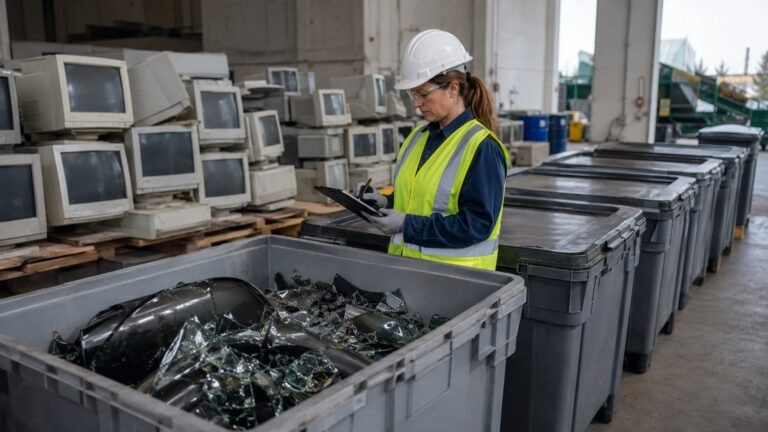
Universal Waste Accumulation Time: How to Prove the One-Year Clock
Choose a reliable federal demonstration method, preserve the earliest date, and document any narrow justification for accumulation beyond one year.

Under the federal universal-waste rules, small and large quantity handlers generally may accumulate universal waste for no longer than one year from the date it became waste or was received. The handler must be able to demonstrate the length of accumulation. Federal rules allow several methods, including dating the container or each item, maintaining an inventory, dating a group or designated area by its earliest item, or using another method that clearly demonstrates the time.
Identify the handler and the waste first
Before applying the clock, confirm that the material is universal waste under the applicable federal and authorized-state program and determine whether the site is a small or large quantity handler. Federal categories include batteries, certain pesticides, mercury-containing equipment, lamps, and aerosol cans, but state programs may add wastes or impose different conditions.
The one-year provisions for small and large quantity handlers appear in 40 CFR 273.15 and 273.35. The clock starts when the item becomes a waste at the site or when the handler receives it from another handler.
The six federal demonstration methods
The federal rules provide flexible ways to demonstrate accumulation time:
- Mark the container with the earliest date any universal waste in it became waste or was received.
- Mark each individual item with the date it became waste or was received.
- Maintain an onsite inventory identifying the date for each item.
- Maintain an onsite inventory identifying the earliest date for a group of items or containers.
- Place waste in a specific accumulation area and identify the earliest date any item in that area became waste or was received.
- Use another method that clearly demonstrates the length of accumulation.
Select a method that matches how material actually moves. A label that is routinely replaced, separated from the waste, or based on the shipment date rather than the earliest accumulation date may not provide reliable evidence.
Use the earliest-date rule consistently
When adding newer items to an existing container, pallet, box, or designated area, retain the earliest applicable date. Restarting the label when a container is consolidated or moved can erase the evidence needed to prove compliance.
If the facility uses an inventory system, connect the record to a physical identifier such as an area, container, pallet, tote, or item number. Reconcile the inventory during inspections and before shipment.
More than one year requires a narrow justification
The federal rules allow accumulation for longer than one year only when the additional time is solely to accumulate enough universal waste to facilitate proper recovery, treatment, or disposal. The handler bears the burden of proving that purpose.
Document the waste type, quantity, dates, operational reason, anticipated shipment threshold, vendor or destination arrangement, and planned shipment date. Convenience, missed pickups, lack of attention, or indefinite storage should not be treated as the regulatory justification.
Build a practical control system
Use one controlled method per waste stream or area and document exceptions. A useful system includes:
- a physical label or area sign tied to the earliest date;
- an inventory with quantity, location, date, and waste type;
- a scheduled warning before the one-year date;
- inspection or reconciliation records;
- outbound shipment documentation; and
- a written approval process for any accumulation beyond one year.
For containers holding multiple waste types or dates, make sure the method still identifies the earliest date applicable to the group.
Common failures
- Dating the container when it becomes full rather than when the first item was added.
- Replacing an old date with a newer date during consolidation.
- Tracking receipt dates in a spreadsheet that cannot be tied to the physical waste.
- Using a shipping schedule without monitoring the regulatory deadline.
- Assuming the transporter or recycling vendor owns the onsite clock.
- Keeping waste beyond one year without evidence that the extension solely facilitates proper recovery, treatment, or disposal.
Field checklist
- Confirm universal-waste status under federal and state rules.
- Determine small or large quantity handler status.
- Identify when each item became waste or was received.
- Select and document one of the allowed demonstration methods.
- Preserve the earliest date during consolidation and movement.
- Reconcile physical items with the inventory.
- Set advance warnings before one year.
- Document and approve any reliance on the limited longer-than-one-year provision.
- Retain outbound shipment records required for the handler category.
Frequently asked questions
Must every universal-waste item have its own date?
No. Individual dating is one option. The federal rules also allow container, group, area, inventory, or another clear demonstration method.
Does the clock restart when waste moves to another room?
No. Internal movement does not change when the waste was generated or received. Preserve the original or earliest applicable date.
Can a handler keep universal waste longer than one year to reduce transportation cost?
Only if the handler can prove that the longer period is solely to accumulate quantities necessary to facilitate proper recovery, treatment, or disposal. Document the facts and verify state rules.
Check your state rules
States may add universal-waste categories, use different requirements, or impose more stringent accumulation and recordkeeping controls. Verify current state adoption before implementing the federal options.
Primary sources
- 40 CFR 273.15 — Small quantity handler accumulation time
- 40 CFR 273.35 — Large quantity handler accumulation time
- 40 CFR 273.9 — Universal-waste definitions
- EPA — Frequent questions about universal waste
Sources reviewed September 30, 2026. Verify the current text and the rules adopted in your jurisdiction before acting.
This article explains a general federal baseline. It is not a facility-specific determination or legal advice. Verify current federal, state, permit, and local requirements for your facts.