Broken and Crushed Universal-Waste Lamps: Federal Baseline and State Variations
Distinguish accidental breakage from intentional crushing and verify the authorized-state rule before choosing a management path.
Federal universal-waste rules require lamps to be managed in containers or packages that remain closed, structurally sound, compatible, and designed to prevent breakage. A handler must immediately clean up and contain lamps that are broken or damaged. EPA distinguishes accidental breakage from intentional crushing: crushing is treatment, and authorized states vary significantly in whether and how they allow crushed lamps to remain under universal-waste standards.
Prevent breakage first
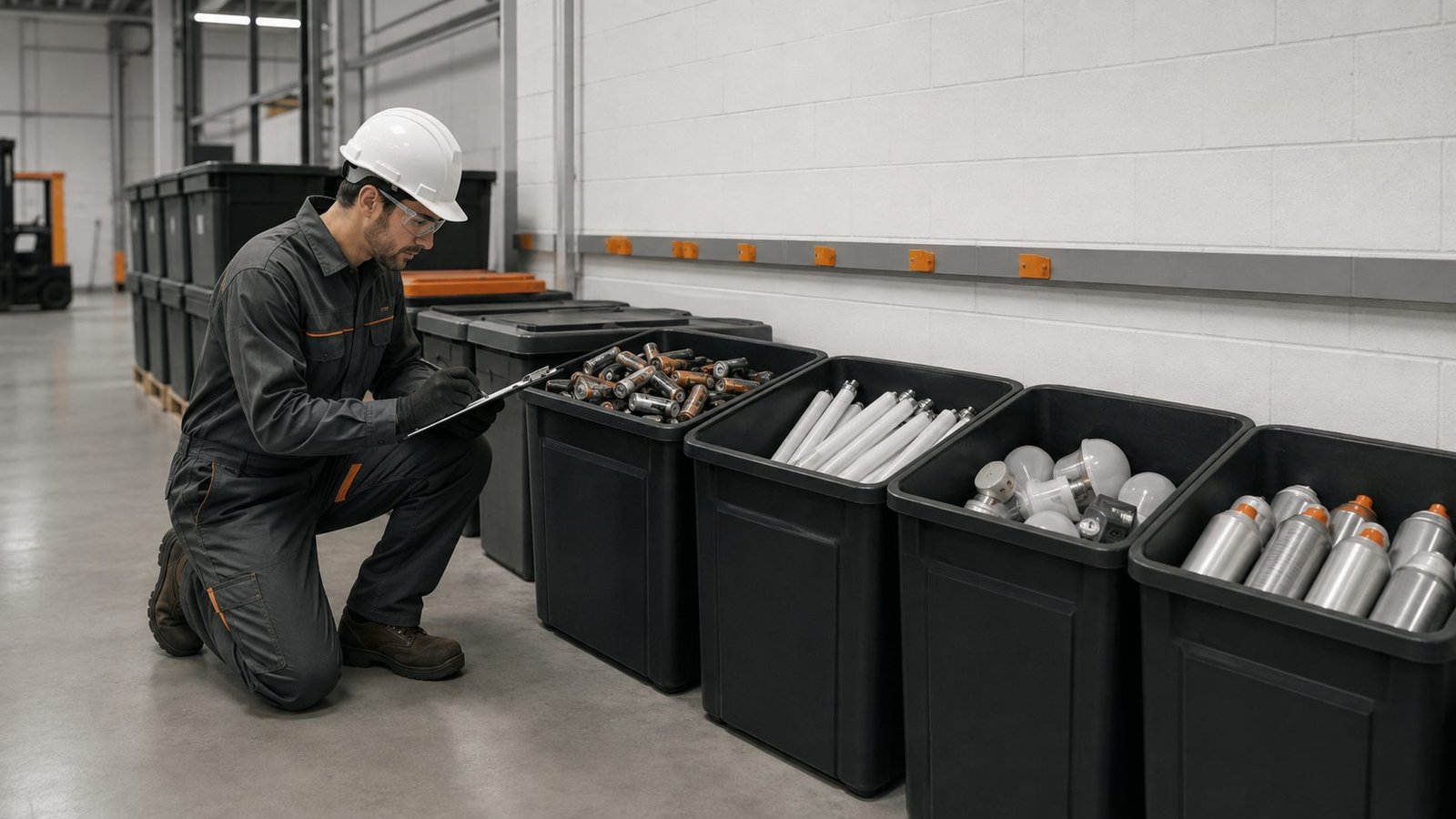
For both small and large quantity handlers, 40 CFR 273.13 and 273.33 require lamp containers or packages that are structurally sound, adequate to prevent breakage, compatible with the contents, and closed. They must lack evidence of leakage, spillage, or damage that could cause a release under reasonably foreseeable conditions.
Choose containers sized and constructed for the lamp type. Close boxes and drums except during active addition or removal. Protect them from impact, water, forklift traffic, unstable stacking, and incompatible materials. Train personnel to place lamps rather than throw or force them into a container.
Respond to accidental breakage
If a lamp breaks or shows damage that could cause a release, immediately clean up and place the material in a closed, structurally sound, compatible container that prevents leakage or releases. Control the area, protect personnel, and use cleanup methods appropriate for mercury or other constituents. Do not use routine dry sweeping or actions that spread contaminated powder without a reviewed procedure.
Document the date, location, lamp type and estimated quantity, cause, cleanup method, container, responsible person, and disposition. Evaluate whether a release, worker-exposure, or state reporting requirement applies.
Distinguish crushing from breakage
Intentional crushing is not the same as incidental breakage. EPA describes crushing as treatment used for volume reduction. The federal universal-waste program does not provide a broad authorization for every handler to crush lamps under Part 273, and state programs take different approaches.
Before purchasing or operating a drum-top crusher, obtain a written applicability review for the state where it will operate. Address treatment authorization, air emissions, worker exposure, equipment operation, residue and filter management, closure, recordkeeping, transportation, and whether crushed material may be shipped as universal waste.
Do not rely only on vendor claims
Equipment marketing, recycler instructions, and a vendor’s acceptance criteria do not determine regulatory status. Ask for the legal basis, state approvals, equipment conditions, emissions controls, filter disposition, training, monitoring, and downstream management. Verify the information with the implementing agency or qualified counsel when the answer is material.
Keep the universal-waste classification analysis separate from occupational-safety controls and shipping classification. All may apply to the same operation.
Manage cleanup residues deliberately
Broken glass, phosphor powder, absorbents, filters, protective equipment, and other cleanup debris need an identified management pathway. Determine whether they remain universal waste under the applicable program or require a hazardous-waste determination and another management standard.
Label and segregate containers so intact lamps, broken lamps, crusher residues, and nonhazardous lamps are not confused. Preserve the earliest accumulation date when materials are consolidated under a universal-waste pathway.
Track accumulation time and shipments
Handlers generally must be able to demonstrate how long universal waste has accumulated and ordinarily may not accumulate it for more than one year, subject to the narrow facilitation provision. Use the earliest date in a container or another method allowed by 40 CFR 273.15 or 273.35.
For large quantity handlers, retain shipment records required by Part 273. For every handler, preserve records that support state authorization, cleanup response, training, quantities, destinations, and any equipment-specific controls.
Field checklist
- Identify each lamp type and its waste determination or universal-waste basis.
- Use closed, compatible containers designed to prevent breakage.
- Protect lamp storage from traffic, weather, and unstable stacking.
- Maintain a reviewed spill and breakage procedure.
- Immediately contain broken or damaged lamps.
- Evaluate cleanup debris, filters, and residues separately.
- Obtain a state-specific written review before intentional crushing.
- Verify air, worker, treatment, shipping, and closure requirements.
- Demonstrate accumulation time using an allowed method.
- Retain shipment, training, cleanup, and authorization records.
Frequently asked questions
Does one accidentally broken lamp automatically lose universal-waste status?
EPA’s federal FAQ states that broken lamps may be managed as universal waste when the Part 273 conditions are met, but authorized states may be more stringent. Immediate cleanup and containment are required.
Is a drum-top crusher simply a universal-waste container?
No. EPA identifies intentional crushing as treatment. The legal pathway depends heavily on the authorized-state program and other applicable requirements.
Can green-tip lamps go in ordinary trash?
Color or marketing does not establish that a lamp is nonhazardous. The generator must make the applicable waste determination and check state requirements.
Check your state rules
States vary on broken lamps, crushing, treatment authorization, emissions, closure, recycling, transporter requirements, and whether crushed lamps remain universal waste. Verify the rules where the lamps are generated, crushed, transported, and received.
Primary sources
- 40 CFR 273.13 — Small quantity handler waste management
- 40 CFR 273.33 — Large quantity handler waste management
- EPA — Frequent questions about universal waste
- EPA — Universal waste
Sources reviewed September 30, 2026. Verify the current text and the rules adopted in your jurisdiction before acting.
This article explains a general federal baseline. It is not a facility-specific determination or legal advice. Verify current federal, state, permit, and local requirements for your facts.